Dolphin Tours guide
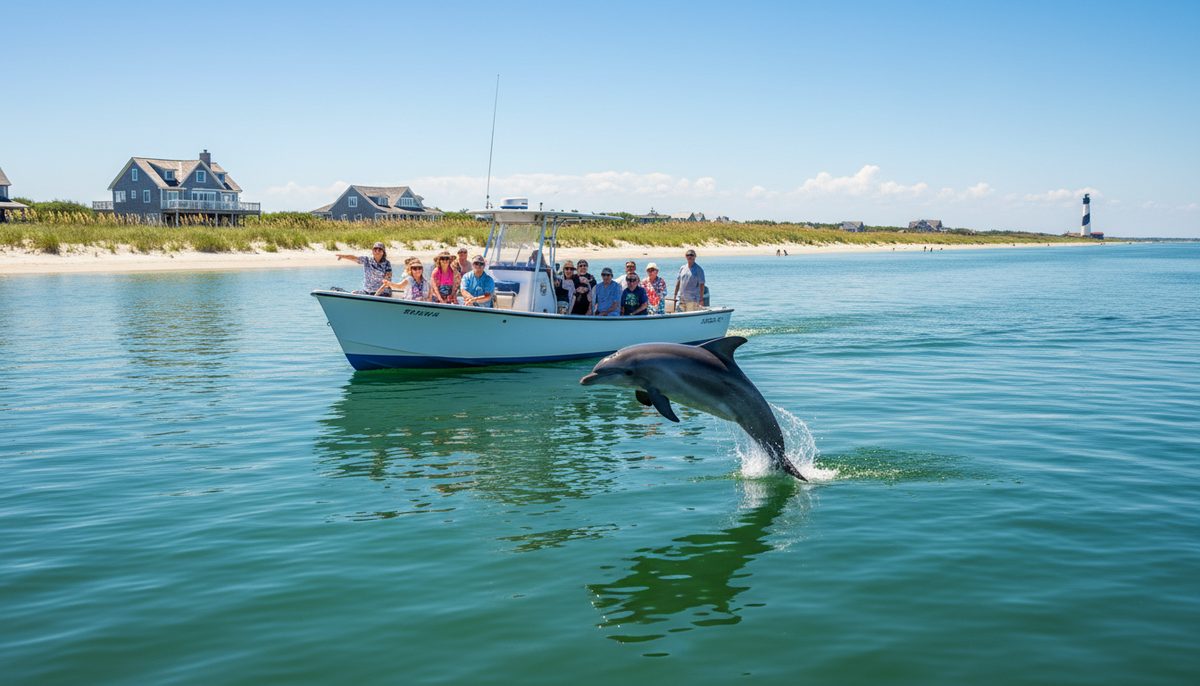
Where dolphins live in the Outer Banks
The Albemarle-Pamlico system is the second-largest estuary in the country, fed by six river basins. Why that hydrology puts bottlenose dolphins in the sounds and where the water concentrates them.
Answer the question with hydrology rather than a map pin and it stops being a guessing game. Dolphins are in these waters because of what the water is: a vast, shallow, brackish system where fresh river flow meets ocean salt behind a chain of barrier islands, producing exactly the conditions that concentrate fish. Understand the plumbing and you can make a decent guess about where the animals will be on a given day, which is more or less what a captain is doing.
The details
Start with scale, because the scale is genuinely unusual. The Albemarle-Pamlico system — the sounds behind the Outer Banks, including the Pamlico and Roanoke sounds where these trips run — is the second-largest estuarine system in the United States, covering over three thousand square miles of estuarine water and draining twenty-eight thousand square miles of land across North Carolina and Virginia. That is not a bay. It is an inland sea with a thin sand barrier between it and the Atlantic, and its sheer area is why the same species that is merely present along most coastlines is genuinely abundant here.
The freshwater side of the equation comes from upstream. Per the estuary partnership, six river basins flow into the sounds: the Pasquotank, Chowan and Roanoke basins ultimately feed Albemarle Sound, while the Tar-Pamlico and the Neuse empty directly into Pamlico Sound. All that river water arrives loaded with nutrients and carrying sediment, and where it meets salt water pushing in through the inlets it produces a salinity gradient — a moving, seasonal, rainfall-dependent boundary that fish organise themselves around. Dolphins organise themselves around the fish.
That habitat type is exactly what the species is built for. NOAA describes common bottlenose dolphins as animals of harbors, bays, gulfs, and estuaries of temperate and tropical waters, found in coastal and estuarine water as well as offshore, and explicitly notes that their habit of living close to shore is what makes them among the most viewable cetaceans in the world. They are not visiting the sounds as a curiosity. This is the kind of water the coastal population occupies as a matter of course.
Within that system, a handful of features do the concentrating. Inlets are the doors: the cuts where sound and ocean exchange water on every tide, funnelling bait through a narrow gap on a predictable schedule. Shoals and channel edges create abrupt depth changes that push fish up against a wall they cannot go through. Marsh edges and grass beds hold juvenile fish. Bridge pilings and marina structure do the same thing artificially. A captain reading the sound is reading those features against the state of the tide, and when the two line up the sighting rate goes up sharply.
Two honest limits on what this page will claim. We are not going to tell you the animals are reliably in any specific cove on any specific morning — they move, the water moves, and a claim like that is unfalsifiable marketing. And we are not going to put month-by-month distribution numbers on the coastal population, because the detailed stock assessment that would support them is not something we have read line by line. What the science supports is the general picture above: the right habitat, at very large scale, close to where the boats leave from.
Dolphins are here because the estuary is enormous, shallow, fed by six river basins, and full of fish — and because this is the water the species lives in anyway. Learn to read inlets, edges and tide, and you will start seeing them from shore as well as from a boat.
On the record: the second-largest estuarine system in the United States (Albemarle-Pamlico National Estuary Partnership — Our Watershed (apnep.nc.gov, retrieved 2026-09-17)) · six river basins flow into the sounds (Albemarle-Pamlico National Estuary Partnership — Our Watershed (apnep.nc.gov, retrieved 2026-09-17)) · harbors, bays, gulfs, and estuaries of temperate and tropical waters (NOAA Fisheries — Common Bottlenose Dolphin species page (fisheries.noaa.gov, retrieved 2026-09-17))
Hand-verified 2026-09-17 against the primary sources named above; where a fact could not be verified it was left out, never guessed.