Dolphin Tours guide
How close can a tour boat get to dolphins?
Fifty yards is a limit on the boat's approach, not a limit on the encounter. What the NOAA distance actually governs, how a captain sets up an approach, and why the dolphins are allowed to close it.
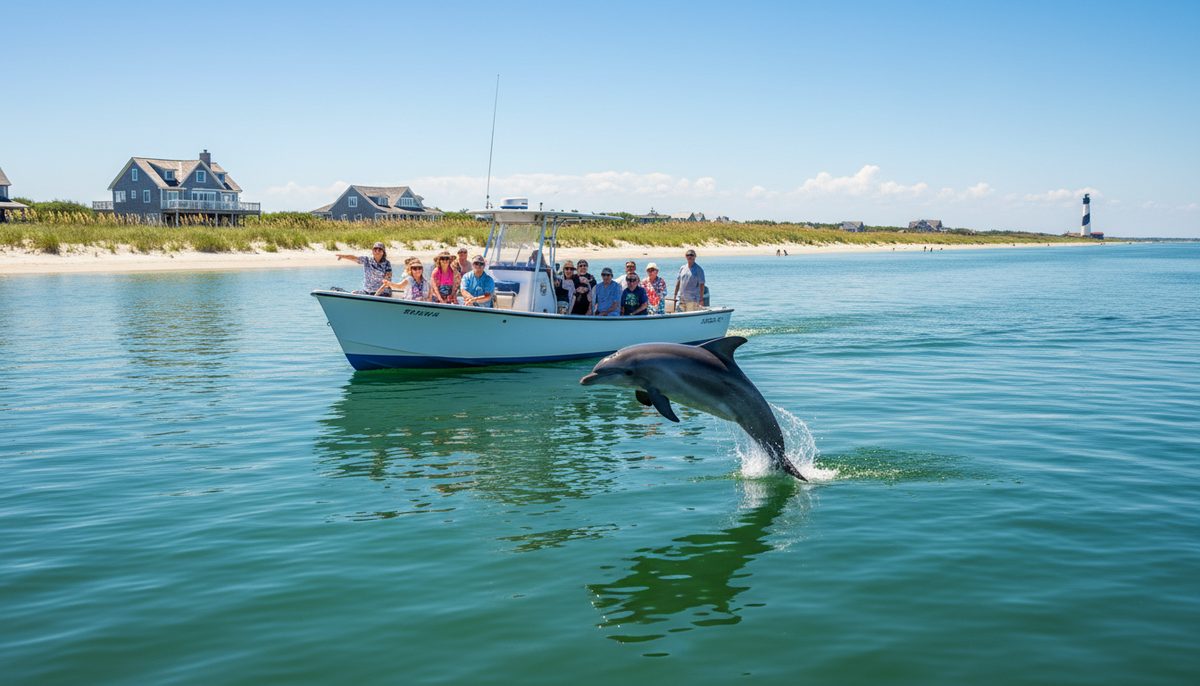
The number is fifty yards, and the sentence that matters most about it is the one nobody prints: it constrains what the boat may do, not what the dolphins may do. A vessel may not put itself inside that ring. An animal that swims into it of its own accord has broken nothing, and neither have you. Almost every disappointment and every argument about this rule comes from reading it as a wall between you and the wildlife rather than as a rule of conduct for the thing with the propeller.
The details
NOAA's Southeast viewing brochure prints the figure with a mental yardstick attached, because fifty yards is hard to judge across open water: Dolphins = 50 yards (1/2 the length of a football field). Get used to that comparison before you go. From a low deck the distance to a dorsal fin is routinely underestimated by half, which is precisely why the guidance gives you a landmark instead of a measurement.
What a good captain does inside that constraint is where the skill lives. The instruction is to Never pursue or follow marine wildlife — move parallel to the animals' course or come in from behind rather than cutting across the front of them, and stand off entirely if another vessel is already working the group. Approaching head-on turns a boat into an obstacle the animals must decide about, and a pod that has to make a decision about you is a pod that leaves. Coming alongside their line at a steady speed, and then idling, leaves them the choice. Very often they take it.
That choice is the whole encounter. Bottlenose dolphins in the sounds are curious, habituated to boat traffic, and entirely capable of deciding a stationary hull is worth a look. When that happens the distance collapses to nothing and the right response is to stop driving — not to chase the moment, not to reposition for a better angle, just to let it happen and let it end. The photographs people remember from these trips are almost always from the minutes after the engine went quiet.
There is a ceiling on the encounter as well as a floor under the approach, and it is the part most visitors have never heard. NOAA asks that you Limit your viewing time to 30 minutes or less, because a group that is watched continuously — by you, and then by the next boat, and then the one after — is being disturbed even when each individual vessel is behaving. A captain who breaks off a good sighting after half an hour is not cutting your trip short. They are the reason the animals are still there in August.
The practical upshot for a paying passenger is simple enough. Do not ask the captain to get closer; the answer will be no, and asking puts a professional in the position of explaining federal law to a customer. Bring binoculars, which convert the legal distance into a genuinely good view, and a lens longer than your phone's if photographs matter to you. And judge the trip by how the captain handles the approach rather than by how near the boat ended up — the ones who set up patiently and then shut down are the ones who see the most.
Fifty yards is the boat's obligation, not the animal's. Hold the distance, cut the engine when a group takes an interest, and the encounter you get will be the one the dolphins chose to give you — which is the only kind worth having.
On the record: Dolphins = 50 yards (1/2 the length of a football field) (NOAA Fisheries — Southeast U.S. Marine Mammal and Sea Turtle Viewing Guidelines brochure (media.fisheries.noaa.gov, retrieved 2026-09-17)) · Never pursue or follow marine wildlife (NOAA Fisheries — Southeast U.S. Marine Mammal and Sea Turtle Viewing Guidelines brochure (media.fisheries.noaa.gov, retrieved 2026-09-17)) · Limit your viewing time to 30 minutes or less (NOAA Fisheries — Southeast U.S. Marine Mammal and Sea Turtle Viewing Guidelines brochure (media.fisheries.noaa.gov, retrieved 2026-09-17))
Hand-verified 2026-09-17 against the primary sources named above; where a fact could not be verified it was left out, never guessed.