Dolphin Tours guide
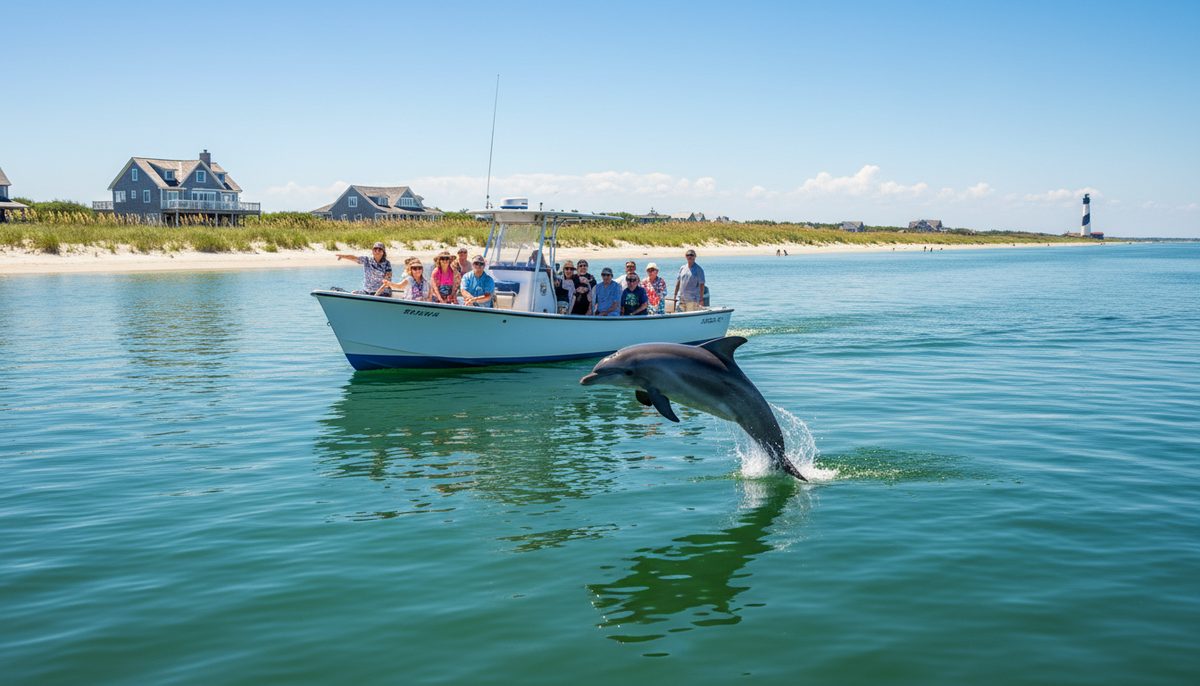
What to expect on an Outer Banks dolphin tour
A dolphin tour is an estuary trip that frequently has dolphins in it. The shape of the two hours, what the captain is actually reading, and the honest odds nobody puts on a booking page.
Reset one expectation before you book and everything else about the trip lands better: this is an estuary excursion that very often contains dolphins, not a scheduled appointment with them. The boat goes out into a shallow, brackish, wind-shaped body of water and looks. Sometimes the looking takes four minutes and sometimes it takes the whole afternoon, and the difference is weather and luck rather than the quality of the operator.
The details
The reason the odds are decent at all is habitat. NOAA describes the common bottlenose as a species of harbors, bays, gulfs, and estuaries of temperate and tropical waters — animals that live close to shore in exactly the kind of water the Outer Banks sounds provide, which is why they are among the easiest whales or dolphins in the world to see from a small boat. You are not going looking for something rare. You are going looking for a common animal in its own back garden, which is a very different proposition from an offshore whale trip.
The first fifteen minutes are logistics and will feel like nothing is happening. You will board at a dock, get a safety briefing that includes where the life jackets are and where not to stand, and then motor through a marked channel at no-wake speed. Sounds are shallow — genuinely shallow, feet rather than fathoms across large areas — so the channel is not a formality and the slow start is not the captain padding the clock. Use that stretch to ask questions; it is the easiest conversation of the trip.
Then the captain starts reading water, and it is worth watching them do it. They are looking for bait activity, for birds working a patch, for the particular flat wake a moving group leaves on calm water, and for the shallow rips where a tide is pushing food into a predictable place. Much of this is invisible until somebody points at it. A captain who narrates that process is giving you the most interesting part of the trip even before a fin appears.
When a group is found the boat slows, comes in on their line rather than across it, and then usually stops. Dolphins = 50 yards (1/2 the length of a football field) is the standoff the vessel holds, and from that range a dorsal fin is clearly visible and a calf alongside its mother is obvious. What follows is quiet and slower than television has led you to expect. There is no leaping on cue. There is breathing, surfacing in a rolling rhythm, occasionally a tail or a roll onto one side, and sometimes an animal that decides to come and look at the hull. The encounter is also time-limited by design: the guidance is to Limit your viewing time to 30 minutes or less, so a conscientious captain will break off and go looking for something else rather than sitting on one group.
Bring more than you think for sun and less than you think for everything else. There is no shade on most of these boats and the glare doubles coming off the water; a hat that stays on in wind, polarised sunglasses that let you see into the water rather than off it, and sunscreen applied before you leave the car. Soft-soled shoes. A light layer even in July, because thirty knots of apparent wind on wet skin is colder than the forecast. Binoculars if you have them. And, honestly, a tolerance for the possibility of a blank trip — some days the sound gives you nothing, and the operators who say so up front are the ones worth booking.
Expect a boat ride through beautiful shallow water with a very good chance of wild animals in it, expect the captain to work for the sighting, and expect the good part to be quieter and briefer than you imagined. Go with that and these trips almost always over-deliver.
On the record: Dolphins = 50 yards (1/2 the length of a football field) (NOAA Fisheries — Southeast U.S. Marine Mammal and Sea Turtle Viewing Guidelines brochure (media.fisheries.noaa.gov, retrieved 2026-09-17)) · harbors, bays, gulfs, and estuaries of temperate and tropical waters (NOAA Fisheries — Common Bottlenose Dolphin species page (fisheries.noaa.gov, retrieved 2026-09-17)) · Limit your viewing time to 30 minutes or less (NOAA Fisheries — Southeast U.S. Marine Mammal and Sea Turtle Viewing Guidelines brochure (media.fisheries.noaa.gov, retrieved 2026-09-17))
Hand-verified 2026-09-17 against the primary sources named above; where a fact could not be verified it was left out, never guessed.