Dolphin Tours guide
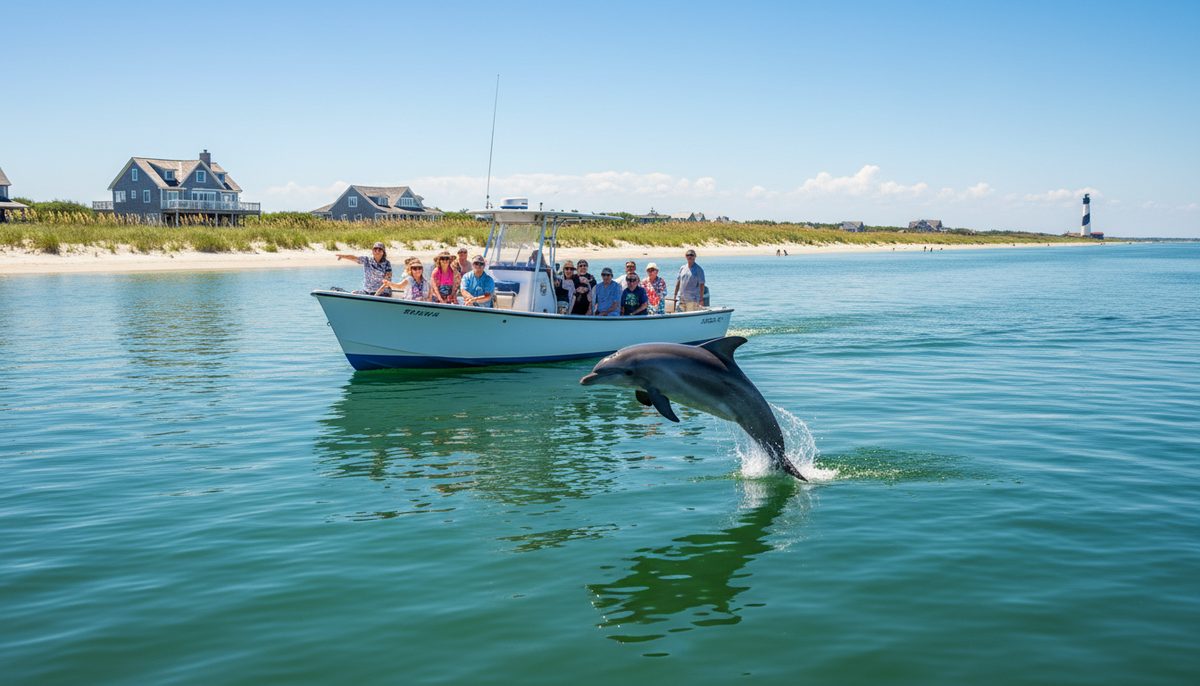
What to do if a dolphin approaches your boat
For private boaters on the Outer Banks sounds: the one control input that matters when dolphins come to you, why drifting is legal, and the difference between an encounter and a pursuit.
This guide is for the person at the wheel of their own boat rather than a passenger on someone else's, because the answer is a control input and only one of you has the controls. When dolphins close on your vessel — riding the bow wave, crossing the stern, surfacing alongside — the correct action is to stop driving. Not to slow down, not to steer away, not to circle for a better angle. Neutral, hands off, let it happen.
The details
NOAA's Southeast guidance says it directly: if a marine mammal approaches, put your vessel's engine in neutral, allow the animal to pass, and then move off slowly once it has. The logic is mechanical rather than sentimental. A turning propeller is the hazard; an animal that has voluntarily come within a few feet of a hull has put itself in reach of it, and the only thing that reliably removes the risk is taking the drive out of gear. Steering away does not, because you cannot predict which side the animal will surface on.
The legal position confuses people and it should not. Nothing about dolphins arriving at your boat is a violation. The prohibition runs the other way: Never pursue or follow marine wildlife, which is to say you may not chase, follow, cut in front of, or repeatedly reposition on animals to keep them near you. An encounter that the dolphins initiated and that you responded to by going neutral is exactly what the guidance wants. An encounter you manufactured by running down a pod at speed is the thing it forbids, and the difference is visible to anyone watching from another boat.
The moment it stops being an encounter is the moment you put it back in gear to stay with them. Bow-riding is the classic trap here: the animals ride your wave, it is genuinely thrilling, and the instinct is to hold your speed and course to keep them there. That instinct is fine as long as you were already going that way and they joined you. It becomes pursuit as soon as you alter course or speed to retain them, and it becomes a problem as soon as you do it for a long time. Hold your line, enjoy it, and do not turn to follow when they leave.
Once they have moved off, resume slowly and look before you accelerate. Dolphins surface unpredictably and a group that has just left your bow may still be under it. Scan a full circle, come up gently, and give the area a wide margin on your way out. If you are anywhere near another vessel that is watching the same group, do not join them — two boats on one group is the situation the guidance is most concerned about, and the second boat to arrive is the one that should leave.
Two standing rules for anyone who spends time on these sounds. Keep Dolphins = 50 yards (1/2 the length of a football field) as your default standoff whenever you are the one doing the approaching — that number is the mental picture to carry, not a figure to look up afterwards. And do not park on a group all afternoon even when they seem untroubled: the guidance to Limit your viewing time to 30 minutes or less applies to private boaters exactly as it applies to commercial ones, and the animals cannot tell the difference between a tour boat and your centre console.
Neutral, hands off, let them pass, then leave slowly and by a wide margin. It is one movement of one lever, it is legal in every direction, and it is the difference between a story you tell for years and a propeller strike you never stop thinking about.
On the record: put your vessel's engine in neutral (NOAA Fisheries — Southeast U.S. Marine Mammal and Sea Turtle Viewing Guidelines brochure (media.fisheries.noaa.gov, retrieved 2026-09-17)) · Never pursue or follow marine wildlife (NOAA Fisheries — Southeast U.S. Marine Mammal and Sea Turtle Viewing Guidelines brochure (media.fisheries.noaa.gov, retrieved 2026-09-17)) · Dolphins = 50 yards (1/2 the length of a football field) (NOAA Fisheries — Southeast U.S. Marine Mammal and Sea Turtle Viewing Guidelines brochure (media.fisheries.noaa.gov, retrieved 2026-09-17)) · Limit your viewing time to 30 minutes or less (NOAA Fisheries — Southeast U.S. Marine Mammal and Sea Turtle Viewing Guidelines brochure (media.fisheries.noaa.gov, retrieved 2026-09-17))
Hand-verified 2026-09-17 against the primary sources named above; where a fact could not be verified it was left out, never guessed.