Dolphin Tours guide
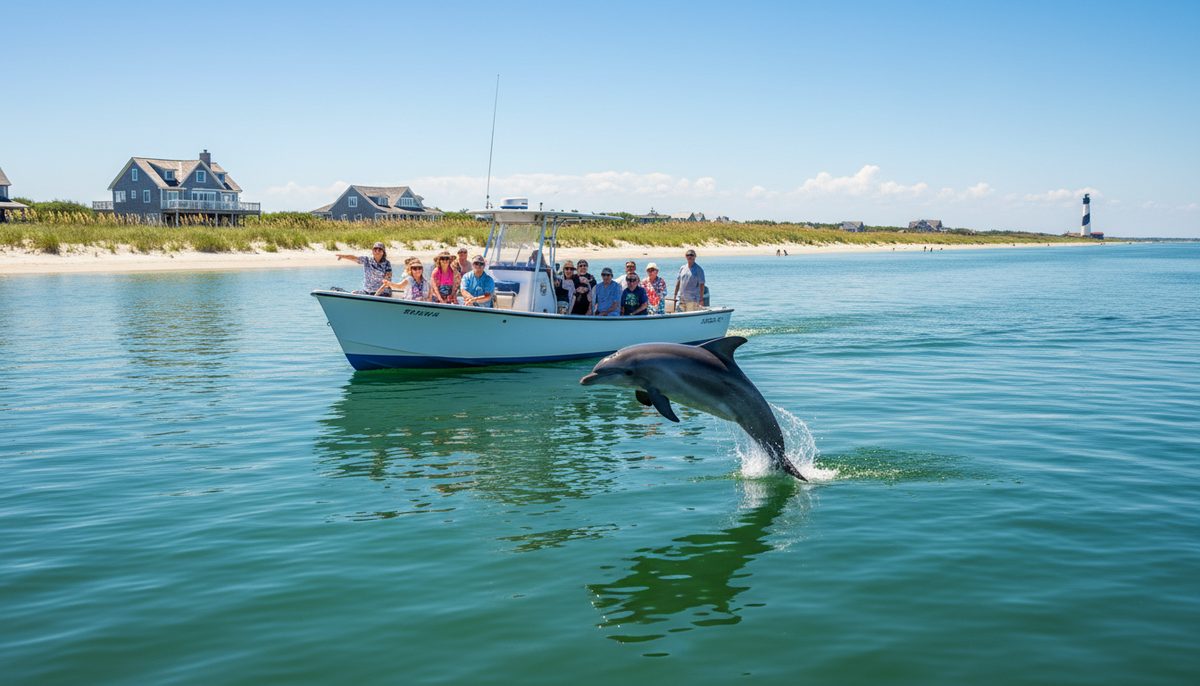
Taking kids on an Outer Banks dolphin tour
The rules that limit a dolphin encounter are the best thing about taking children on one. Managing attention spans, what to tell them beforehand, and the behaviours worth teaching them to spot.
Yes, with one preparatory conversation that most families skip and later wish they had not. Children arrive at these boats with a picture in their heads assembled from aquarium shows and cartoons — dolphins that come when called, that can be touched, that perform. Wild animals in a sound do none of that, and a child who has been told the real version in advance is delighted by what actually happens, while a child who has not spends the trip waiting for a show that never starts.
The details
Start with the rule that will otherwise cause the one unhappy moment. Federal guidance is unambiguous that you must Do not swim with, ride, pet, touch, or attempt to interact — no swimming with them, no reaching over the rail, no hand in the water hoping for contact. Framed as a prohibition, that lands as a disappointment. Framed as what it actually is — that these are wild animals with their own lives going on, and that we are the visitors — it becomes the point of the outing rather than a restriction on it. Children take that framing far better than adults expect, and several come home repeating it to relatives.
Then do the arithmetic on attention. NOAA asks vessels to Limit your viewing time to 30 minutes or less, so even a perfect trip is not thirty minutes of unbroken dolphin: it is a transit out, a search, an encounter capped at half an hour, and a transit back. For a six-year-old, the search phase is the part that will test them. The fix is to give them a job — spotting, counting, watching for birds — which turns waiting into participation. Captains are generally happy to make a small child the official lookout, and the position comes with real responsibility.
Teach them one thing to watch for and the whole trip levels up. NOAA lists the disturbance signals a vessel is supposed to respond to — Rapid changes in direction or swimming speed. Erratic swimming patterns. Escape tactics among them, along with prolonged diving, tail slapping, and a female moving between her calf and a boat. A child who learns to notice a mother shielding a calf and reports it to the captain has just done applied field biology, and the captain will treat the report seriously. That single lesson does more for a kid's interest in the ocean than any amount of narrated commentary.
Practical notes, briefly. Under-fives find these trips long; two to three hours on a moving deck in the sun is a lot of small person. Motion sickness medication works as prevention and does nothing as a cure, so give it the night before and again in the morning if there is any history of it. Life jackets are required for children on the water and the boat will have them, but a child who has worn one before is a child who will not fight it at the dock. Pack water, pack more than you think, and pack a snack that survives being sat on.
Manage the expectation about distance, too. The boat holds Dolphins = 50 yards (1/2 the length of a football field) off, which is farther than a child imagines from the photos, and a small pair of binoculars turns that from a letdown into the best toy on the boat. If the animals come closer it is because they chose to — which is worth saying out loud when it happens, because that is the moment a child understands the difference between a wild animal and an exhibit.
Tell them the truth beforehand, give them a job during the search, and hand them binoculars. Children who go out expecting a wild animal rather than a performance come off these boats talking about it for the rest of the week.
On the record: Do not swim with, ride, pet, touch, or attempt to interact (NOAA Fisheries — Southeast U.S. Marine Mammal and Sea Turtle Viewing Guidelines brochure (media.fisheries.noaa.gov, retrieved 2026-09-17)) · Limit your viewing time to 30 minutes or less (NOAA Fisheries — Southeast U.S. Marine Mammal and Sea Turtle Viewing Guidelines brochure (media.fisheries.noaa.gov, retrieved 2026-09-17)) · Rapid changes in direction or swimming speed. Erratic swimming patterns. Escape tactics (NOAA Fisheries — Guidelines and Distances for Viewing Marine Life (fisheries.noaa.gov, retrieved 2026-09-17)) · Dolphins = 50 yards (1/2 the length of a football field) (NOAA Fisheries — Southeast U.S. Marine Mammal and Sea Turtle Viewing Guidelines brochure (media.fisheries.noaa.gov, retrieved 2026-09-17))
Hand-verified 2026-09-17 against the primary sources named above; where a fact could not be verified it was left out, never guessed.