Pricing guide
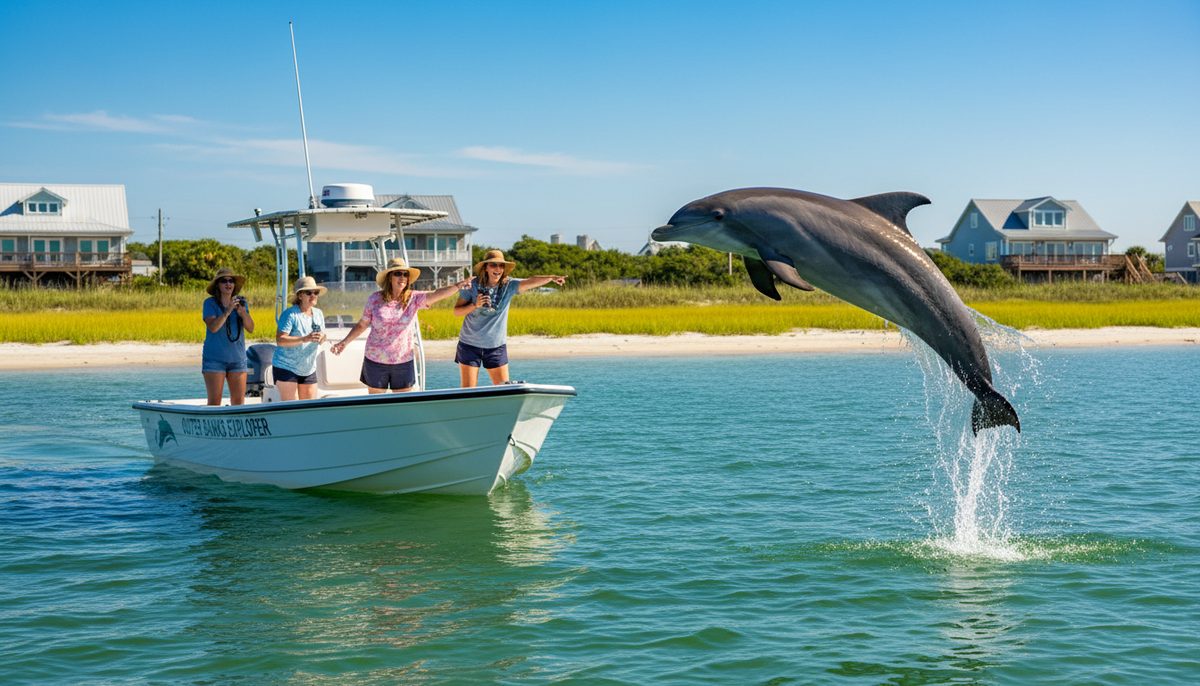
What an Outer Banks dolphin cruise costs
What an Outer Banks dolphin cruise costs and why: the six-passenger legal threshold that decides which boat you are buying, the viewing ceiling that caps animal time, and the five questions that make two quotes comparable.
Why this page does not open with a number
Search this question and you will be handed a tidy per-person range inside three seconds, usually with no indication of where it came from or when anybody last checked. We are not going to add to that pile. No published, dated, authoritative rate schedule exists for Outer Banks dolphin cruises — fares move with fuel, with the size and age of the vessel, with whether the seat is shared or the boat is yours, and with which fortnight of the summer you are asking about — so a range printed here would be a guess with a decimal point glued to it.
What we can do is separate the parts of the number that are fixed by federal law, which can be stated precisely, from the part that belongs to the boat, which only the boat can honestly quote. Do that and a fare stops being a mystery. Most of the spread between two cruises that look identical on a booking page comes from three structural facts, and all three are public.
Six passengers is the hinge the whole price swings on
The single most consequential number in this market is not a fare at all. Under 46 USC 2101(51), an uninspected passenger vessel of less than 100 gross tons may carry not more than six passengers with at least one of them for hire. Cross that line — put a seventh paying passenger aboard — and the vessel is no longer uninspected. It needs a Coast Guard Certificate of Inspection and a Master-credentialed operator rather than the six-pack endorsement, which means a different hull, a different maintenance regime, and a different cost base behind the ticket.
That threshold splits the local fleet into two genuinely different products. The small boat sells intimacy: six people, one conversation, a captain who can answer you directly. The inspected vessel sells volume: more seats, a lower price per seat, a deck you share with strangers. Neither is the better buy in the abstract. But a family of eight is booking either two small boats or one larger inspected one, and discovering that at the dock is a bad way to start a holiday.
You are buying a window of water time, not a quantity of dolphins
Here is the part almost nobody prices correctly in their own head. A ticket buys you a departure, a hull, a captain and a block of time on the sound. It does not buy animals, and no honest operator will tell you otherwise. More than that: the amount of animal time a trip can legally contain is capped. NOAA's viewing guidance is explicit — Limit your viewing time to 30 minutes or less — because prolonged attention from one or more vessels is itself the disturbance. A three-hour cruise is therefore not six times as much dolphin as a half-hour one. It is more water, more distance covered, and more chances to find a group, with the same ceiling on what happens once you do.
The approach distance works the same way. Dolphins = 50 yards (1/2 the length of a football field) is the floor on how close a vessel may put itself, and it does not get shorter because you paid more. A premium fare buys a captain who knows where to look, a hull that can sit quietly, and someone who will explain what you are watching. It does not buy proximity. Any operator implying it does is either misinformed about the rules or telling you they intend to break them, and the second is worse.
Shared seat, whole boat, and the arithmetic in between
Most operators sell two things. The shared cruise puts you on a scheduled departure alongside other parties and prices per head; the private charter sells the vessel for a block and prices per boat. The crossover point is arithmetic rather than taste: below it, buying seats is cheaper; above it, the whole boat costs less per person and gives you the schedule as well. Work out your party size first and ask for both numbers — a reputable operator will tell you which side of the line you are on without being pushed.
Private also buys the departure time, which matters more than people expect. A shared trip leaves when the schedule says; a chartered boat leaves when the water is right, which on a wind-driven estuary is not the same thing as when the clock says. If your party contains a nervous first-timer, a toddler on a nap schedule, or somebody who wants photographs in specific light, the private premium is buying flexibility rather than exclusivity.
What moves the number between May and October
Season is the largest single variable, and it is the one you can actually use. The fortnight either side of Independence Day and the first two weeks of August are when every hull on this coast is spoken for, and no operator discounts a boat that is already full. The shoulder weeks — late May, early June, the back half of September, October — are when a captain has room to talk, when departures are less crowded, and when the water is frequently better behaved.
Duration is the second driver, and it is not linear. The first hour of any trip is mostly transit: getting off the dock, out of the channel, and onto water worth looking at. A trip an hour longer is not an hour more of the good part, it is a genuinely larger search area, which matters on a day when nothing is showing near the marina. Fuel is the third, and it is the reason the same boat quotes differently for a sound run and a longer loop. Crew is the fourth: a second person aboard who can narrate, watch the water, and keep an eye on children is a real cost that a one-person operation does not carry.
Five questions that make two quotes comparable
Ask these before you ask the price, and the price will start making sense. How many passengers is this vessel rated for — six, or more? How long is the trip from lines-off to lines-on, as opposed to the advertised headline? Is this a shared departure or the whole boat? What happens if the wind comes up: rescheduled, refunded, or shortened at full fare? And what is the operator's policy if no dolphins are found — is there a second trip, or is the money gone?
That last one separates operators faster than anything else on this list. The shallow, wind-driven sounds these cruises run on are genuinely variable, the animals are wild, and any business selling a guarantee is selling something it cannot deliver. A captain who says plainly that some days are blank, and who has a policy for it written down, has told you more about the trip you are buying than any photograph on a booking page.
Tell us the date, the size of your party, and whether you want a scheduled departure or the boat to yourself, and you will get a firm number for that day — with the six-passenger question and the weather policy answered before you have to ask.
On the record: 46 USC 2101(51) (Office of the Law Revision Counsel: 46 U.S.C. § 2101 — General definitions (uscode.house.gov, retrieved 2026-09-17)) · Dolphins = 50 yards (1/2 the length of a football field) (NOAA Fisheries — Southeast U.S. Marine Mammal and Sea Turtle Viewing Guidelines brochure (media.fisheries.noaa.gov, retrieved 2026-09-17)) · Limit your viewing time to 30 minutes or less (NOAA Fisheries — Southeast U.S. Marine Mammal and Sea Turtle Viewing Guidelines brochure (media.fisheries.noaa.gov, retrieved 2026-09-17))
Hand-verified 2026-09-17 against the primary sources named above; where a fact could not be verified it was left out, never guessed.